St Thomas’s is a Church of England worship space and was founded and built in 1982 as a small church plant by St Martin’s – and is within the parish bounds of that church. It comprises a large hall, meeting room and well appointed kitchen. The entrance doors feature glass engravings by David Kindersley. St Thomas’s hosts regular services and is popular as a venue for hire.
Good description, but more correctly it is Holy Sepulchre Church, built to imitate the Church of the Holy Sepulchre in Jerusalem. It is one of only 5 surviving round churches of the 11th and 12 cents. in England. It is now a “Visitor Centre”; the congregation having relocated to St Andrew the Great.
The castle is no longer but leaves a church of flint and stone. The (aisleless)nave roof is king posted with tie beams on head corbels. Only the dado remains of the rood screen.
An absolutely stunning Norman church, and bits of it are even older, some recycled from Roman buildings that used to be there. It’s covered inside and out in fascinating carvings. There are animals, people, men fighting, and if you look carefully you can read the date – 1124, or is it 1114 or 1104?
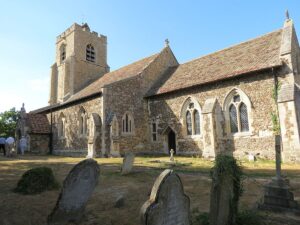
The Chancel is late 13th century with the nave, south aisle and tower 14th to 15th century. William White, architect, heavily restored the church in 1863-9 when the south aisle and south porch were rebuilt, but arguably in a simple, sympathetic and non-invasive way. He kept the internal plaster and clearly did not see the need to add a north aisle at that time. The nave and south aisle windows are Victorian but do match the original Chancel windows. The Chancel sedilia fits well with a simple bench and the south aisle piscina, which would have been a chapel, has a simple ogee arch. The Chancel screen is very simple with painted panels at floor level depicting the saints – including St Etheldreda, St Andrew and St Peter. Perhaps he couldn’t resist adding the corbel angels in the nave roof though.
Methodists have worshipped in Chesterton for over 200 years beginning with outdoor preaching in the mid to late 18th century, then ‘cottage meetings’ in the early 19th century. The first ‘Wesleyan’ chapel was opened in 1858 and is still standing on the High Street (now Chesterton Working Mens Club). The current site is the third Methodist site in the ‘village’, purchased in the 1930’s at the same time as the Hundred Houses Society began to build social housing just across the fields.
The Chancel is 12th century but the Chancel arch was rebuilt in 1885. The aisles, clerestorey and nave roof all date from the 15th century after a major fire. Some medieval painting still survives on the columns. There was a thorough restoration in 1883 and the rood screen, once vaulted, is now only a fragment of its former shape. The chapel screen in the north aisle is by architect, Sir Albert Richardson. The tower was restored in 1994. The font is modern.
Set in its distinctive small village on a low ridge with views across the fens to Ely, St Peter ad Vincula is a small but fine 13th century aisle-less church, with a 14th century tower and alterations, a richly furnished interior and a 15th century roof structure. In the 1890s Athelstan Riley, patron of the living, arranged the installation of many notable fittings – reredos with late 15th century reliefs of the Passion, rood screen surmounted by carved and painted Crucifixion, St Mary and St John, 18th century Danish pulpit with painted panels, 18th century Dutch chandelier. At that time also the thatched roof, then the sole remaining example in the area, was replaced by the present Westmorland slate roof. Inside there are also 20th century painted relief Stations of the Cross and benches c.1500 with Instruments of the Passion and other carvings. Recent changes to management of the churchyard in line with the Eco Church initiative have achieved an A Rocha Bronze award and a silver churchyard conservation award from the Wildlife Trust.